How to Tell If a Job Offer Abroad Is Fake
Fake job offers can look surprisingly convincing, especially when they involve real companies, professional-looking recruiters and promises of relocation or visa sponsorship. This guide explains how to verify the company, recruiter, vacancy, sponsorship claims, contract and payment requests before trusting an international job offer.

You find it at 11:47 p.m. A company in another country is hiring, the salary is great, relocation is included and they might even sponsor your visa. The role sounds suspiciously similar to the thing you have been trying to find for the last six months.
Three applications, two interviews and one minor existential crisis later, perhaps this is finally it.
Or perhaps “Sarah from Global Recruitment” is about to ask you to send €600 to a bank account in exchange for a visa that does not exist.
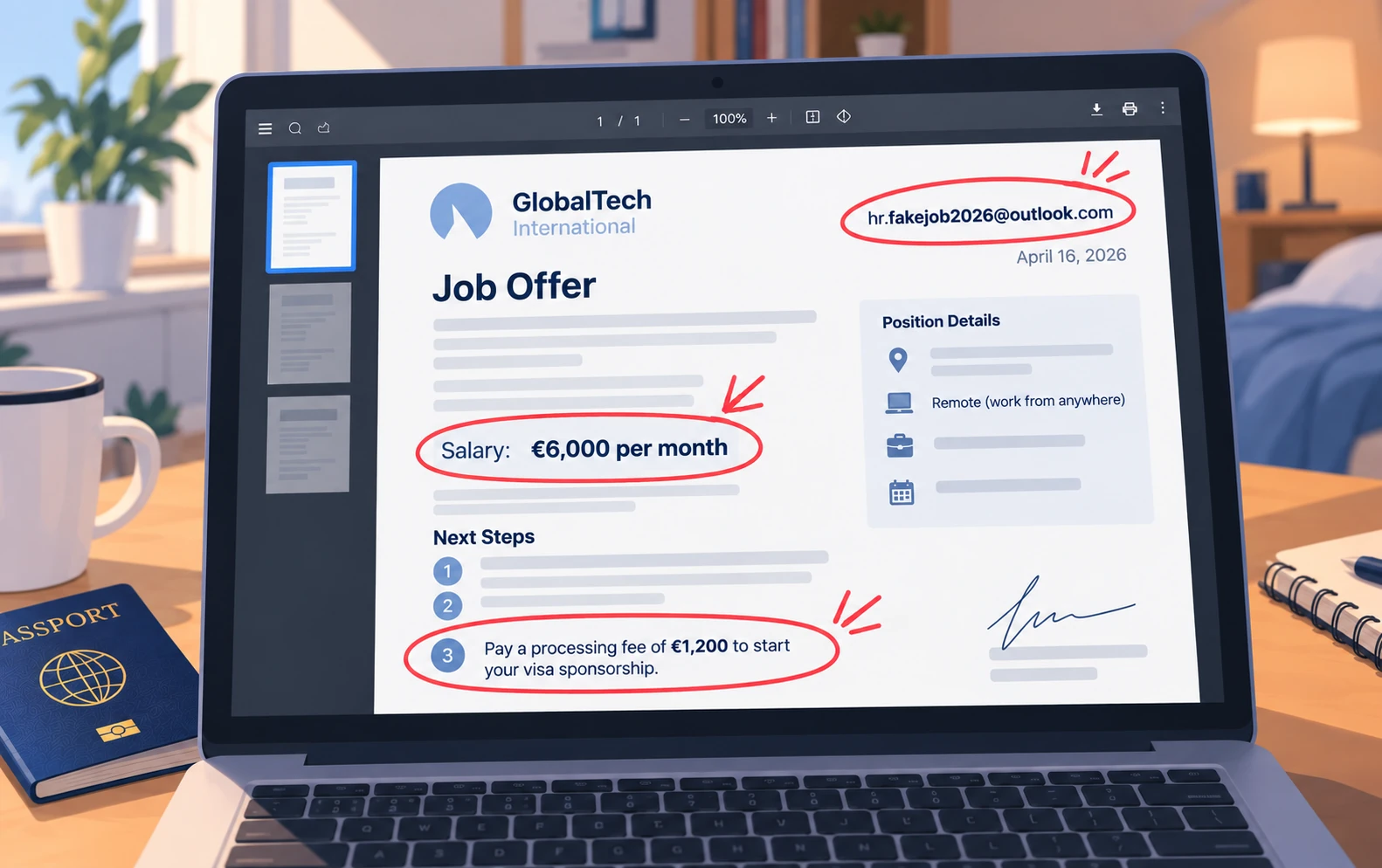
Unfortunately, fake job offers can look remarkably convincing. Scammers can copy the branding of real companies, impersonate actual employees, reproduce genuine job descriptions and create websites or email addresses that look almost identical to legitimate ones. The FBI has specifically warned about fraudsters using information from real companies — and sometimes the identities of real employees — to make fake vacancies appear authentic.
So the question should not simply be: “Does this offer look professional?” A beautifully designed PDF, a convincing LinkedIn profile and a company logo are all very easy things to reproduce.
The much better question is: can you independently verify the important parts of the offer?
A real company does not automatically mean a real job
This is probably the most important thing to understand.
Imagine you receive an offer from Very Real International Ltd. You Google the company and everything looks reassuring. It has a proper website, employees on LinkedIn, years of business activity and perhaps even a photo of an office containing the obligatory suspiciously expensive coffee machine.
Excellent. You have established that the company exists.
What you have not established is that the person contacting you works for that company or that the vacancy they are offering actually belongs to it. The FBI has warned about scammers copying genuine job advertisements, changing the contact information and republishing them elsewhere. Fraudsters can also create websites, phone numbers and email addresses specifically designed to resemble those of a legitimate employer.
Your verification therefore needs to answer two separate questions: is the company real, and is this particular opportunity really connected to that company?
Start with the employer’s official careers page and search for the position there. Not finding it does not automatically mean the offer is fraudulent — companies sometimes use recruitment agencies, conduct confidential searches or remove listings after receiving enough applications — but it gives you a reason to investigate further.
If you still have doubts, contact the company independently. Find its contact details through its official website rather than using the phone number, email address or link provided by the recruiter you are trying to verify. The FTC specifically recommends contacting companies directly using information you know to be legitimate when you are unsure whether a recruiter really represents them.
Public company registers can provide another layer of verification. In the United Kingdom, for example, Companies House allows anyone to check information such as a company’s registered address, status, officers and filing history.
Just remember what that proves: the company exists. It does not automatically turn the person messaging you into its HR manager.
Look very closely at who is contacting you
Email addresses deserve much more attention than most of us give them.
EURES, the European employment cooperation network, advises jobseekers to check whether messages claiming to come from an employer actually use the employer’s official domain and to look carefully for spelling changes or misleading variations.
Imagine that the real company uses:
@company.com
but your recruiter writes from:
@company-careers.com
Those addresses may look related, especially when you are reading an email quickly on your phone, but they are completely different domains. The second one is not automatically fraudulent — some companies genuinely use separate recruitment platforms or domains — but it should be verified rather than trusted because it looks familiar.
A recruiter claiming to represent a large company while writing from a personal Gmail, Yahoo or similar account also deserves extra scrutiny. The FTC notes that legitimate corporate recruiters generally contact applicants using corporate email accounts.
You can also search for the recruiter themselves. Do they appear on the company website or on credible professional profiles? Does their employment history make sense? Can the company confirm that they work there?
Unfortunately, even finding an actual employee with exactly the same name does not completely solve the problem. Scammers can impersonate real employees too.
Welcome to international job hunting in 2026. Apparently we are all part-time detectives now.

When the recruitment process moves suspiciously fast
Real international recruitment usually involves at least some friction. Someone needs to read your CV, determine whether your experience fits the role and, at some point, have an actual conversation with you.
The UK Disclosure and Barring Service includes receiving a job offer without an interview among the warning signs of recruitment fraud. The FTC has also warned about fake recruiters sending convincing employment offers and asking candidates for sensitive financial information before any genuine interview has taken place.
That does not mean every legitimate recruitment process needs seven interviews, a personality test, three references and lunch with the founder. Hiring processes differ enormously, and some companies really are impressively fast.
The problem is when an employer seems almost completely uninterested in finding out who you are. If you applied this morning and by lunchtime somebody has decided to employ you, relocate you to another continent and potentially sponsor your immigration process without asking a single meaningful question about your experience, it is worth slowing things down before buying the plane ticket.
Even an interview is not proof on its own. The FBI has documented fake-employment schemes in which victims completed virtual interviews and received apparently official employment contracts before being asked for personal and financial information.
Money is where things become particularly serious
A suspicious recruitment process becomes considerably more dangerous when somebody starts asking you to pay.
The FTC advises jobseekers not to pay someone for the promise of employment. It also warns about schemes in which fake employers send candidates cheques, ask them to purchase equipment or transfer money and later leave the victim responsible when the original payment turns out to be fraudulent.
The International Labour Organization takes a similarly strong position in its fair recruitment principles. Its guidance states that workers and jobseekers should not be charged, directly or indirectly, recruitment fees or related recruitment costs. At the same time, national legislation can contain limited exceptions in specific circumstances, so this principle should not be simplified into “every expense connected with starting a job is illegal everywhere”.
That distinction becomes especially important with international employment.
A real immigration process can involve legitimate costs such as government visa fees, translations, medical examinations, certificates or other documentation depending on the destination country and immigration route. Having to pay a government visa fee therefore does not automatically mean that somebody is trying to scam you.
What should make you much more cautious is something like: “Congratulations, you have the job. Transfer €850 to our recruitment agent’s personal account and we will secure your visa sponsorship.”
Before paying anything, find out exactly what the payment is for, who officially charges it, whether the amount appears on the relevant government website and where the payment is supposed to be made.
“Trust me, bro, immigration is complicated” is not an official payment method.
Visa sponsorship should also be independently verifiable
If an employer claims that it can sponsor your work visa, the way you verify that claim depends on the country. Immigration systems vary enormously, and there is no universal global register of companies that can sponsor foreign workers.
Where an official register exists, however, use it.
The United Kingdom is a particularly useful example. Employers generally need a sponsor licence to sponsor eligible workers through the relevant Worker and Temporary Worker routes, subject to the rules and exceptions of the immigration system. The UK government publishes an official register of licensed sponsors that jobseekers can search themselves.
This kind of verification is not merely theoretical. In July 2026, the UK Insolvency Service announced that Medrecruiter Limited had been shut down after an investigation into its recruitment activities. According to the agency, 23 people from Nigeria, Pakistan and the Philippines lost more than £19,000 after paying upfront fees for promised recruitment and visa sponsorship services.
The investigation found that Medrecruiter was not on the Home Office register of licensed sponsors, had not submitted a single visa application and provided no evidence that it had successfully placed anyone into employment.
The disturbing part is that several elements of the process looked legitimate. There were interviews, contracts and payments described as being for things such as consultation, training, uniforms and processing.
What there apparently was not was an actual job.
That case illustrates why the most useful verification happens outside the recruitment conversation. Do not ask the person selling you the opportunity to prove that the person selling you the opportunity is legitimate using information that they themselves provide. Wherever possible, go to official sources.

Sometimes your personal information is the target
Not every fake job offer is designed to extract an immediate payment.
Sometimes the thing the scammers want is your identity.
A passport, home address, bank account details, tax information or other identification documents can be extremely valuable. The FBI has documented fraudulent recruitment schemes in which applicants were asked to provide identification numbers, driver’s licences, direct-deposit information and credit card details after supposedly being offered employment.
The FTC has similarly warned about fake recruiters requesting financial information for supposed employment paperwork before properly interviewing or hiring the candidate.
This requires some nuance, because real employers obviously do need personal information at certain stages. International employment can legitimately require a passport, proof of identity, evidence of your right to work or documents needed for an immigration application.
The important question is therefore not simply, “Have they asked me for a document?” It is whether the request makes sense at that stage of the process.
Before sending sensitive information, you should know who is receiving it, why they need it, whether you have independently verified the employer and recruiter and whether the request fits the procedure you are supposedly completing.
Your passport is not something to send to a stranger just because their email signature contains a nice blue logo.
Read the contract as if you are actually going to move there
International job offers eventually need to become specific.
Who is your legal employer? Where will you work? What exactly will you do? What will you earn? What are your working hours? What benefits have been promised? How does relocation work? What happens with your immigration process? When are you expected to start?
The ILO’s fair recruitment guidance says that employment terms should be specified in an appropriate, verifiable and easily understandable way, preferably through written contracts. For migrant workers in particular, its guidance states that contracts should be provided sufficiently before departure, in a language the worker understands, and that workers should be protected against contract substitution.
That last point matters because not every dangerous international job offer is completely imaginary. Sometimes a real position exists, but the conditions waiting for the worker are substantially different from the ones that convinced them to travel.
Perhaps the salary suddenly changes. Maybe the employer is different. The promised city becomes another city. Accommodation turns out to be deducted from wages. A permanent position mysteriously transforms into temporary work.
Major changes like these should not be treated as administrative trivia simply because you have already packed your suitcase. If a fundamental condition changes, verify what is happening before you travel or sign anything new.
Ready to look for a job abroad?
Browse international opportunities on No Borders Abroad and find roles that may offer relocation support.
Explore international jobs
Be particularly careful if the destination itself changes
Most recruitment scams are designed to steal money or information, but false overseas job offers can sometimes lead to much more serious situations.
In 2023, the FBI warned about fake job advertisements linked to labour trafficking at scam compounds in Southeast Asia. Victims were recruited for jobs described as things like technical support or call-centre customer service, sometimes with competitive salaries, travel expenses and accommodation included. According to the FBI warning, the location of the position was sometimes changed during the recruitment process.
This is an extreme scenario and it would obviously be irresponsible to suggest that every employer changing an office address is involved in trafficking.
What the warning does illustrate is that the location of an international job is a fundamental part of the offer. If you accepted a position in one country and somebody later tells you that you first need to travel somewhere else, do not treat that as a minor logistical change.
Verify it independently with the company and, where appropriate, through official immigration or consular sources before travelling.
Does WhatsApp or Telegram mean the offer is fake?
No — but context matters enormously.
The FTC has warned about unexpected recruitment messages arriving through text messages, WhatsApp and Telegram, particularly schemes offering vague online jobs or simple digital “tasks” before eventually asking victims to deposit their own money.
That does not make the messaging app itself evidence of fraud. Recruiters in many countries and industries genuinely use WhatsApp, Telegram and similar platforms, especially after making initial contact elsewhere.
There is a considerable difference between a verified recruiter from a real company who interviews you and later says, “I’ll send you tomorrow’s meeting details on WhatsApp,” and an unknown number appearing from nowhere with: “HELLO. We reviewed your profile. REMOTE ONLINE OPTIMIZATION SPECIALIST. €400 DAILY. Reply YES.”
The first one might be perfectly normal. The second one should at least activate your suspicious eyebrow.
A famous job board cannot verify everything for you
Finding a vacancy on a large and reputable platform can make an opportunity feel safer, but it should not replace your own checks.
The FBI has documented scammers using legitimate recruitment websites to publish fraudulent vacancies while impersonating real companies. That means a vacancy appearing on a major job platform does not prove that every person, website or communication connected to it is genuine.
The same principle applies wherever you discover the opportunity: a general job board, LinkedIn, a university platform, social media or a specialist international employment website. That includes No Borders Abroad: finding a job here should still be the beginning of your own verification process, not the end of it.
Think of the platform as the place where you found the opportunity, not as an unconditional guarantee of everything that happens afterwards.
Once communication moves elsewhere, especially when sensitive documents, money, immigration procedures or international travel become involved, continue verifying the information independently.
A real opportunity should survive scrutiny
Moving abroad for work already requires a fairly impressive amount of optimism.
You may be changing country, workplace, home, immigration status, language and possibly the supermarket in which you will spend twenty minutes trying to identify normal milk.
You should not have to add “accidentally sent my passport and savings to a fictional HR department” to that list.
The point of all these checks is not to become suspicious of every international opportunity. Real companies hire people from abroad every day, recruiters genuinely contact candidates online and legitimate immigration procedures often involve sending documents and completing complicated paperwork.
The goal is simply to make sure that the exciting opportunity in front of you can withstand basic verification.
Check the company, but also check the vacancy. Verify the recruiter, not just their name. Look carefully at the email domain. Confirm visa sponsorship claims through official sources whenever possible. Understand every payment before you make it, and be especially cautious when someone asks you to send money directly to them. Do not provide highly sensitive information before you know exactly who is receiving it and why.
And if the employer, location, salary or other fundamental conditions change after you accept the offer, stop and find out what changed before continuing.
A genuine job does not become less genuine because you checked it.
That is exactly the kind of job you want to move countries for.
Sources and further reading
The main sources used for this article include:
EURES — How to spot fraudulent job offers and misinformation
U.S. Federal Trade Commission — Job Scams
U.S. Federal Trade Commission — Job scammers are looking to hire you
U.S. Federal Trade Commission — That job offer text is probably a scam
FBI Internet Crime Complaint Center — Scammers impersonating legitimate businesses in job postings
FBI Internet Crime Complaint Center — False job advertisements linked to labour trafficking
International Labour Organization — General Principles and Operational Guidelines for Fair Recruitment
International Labour Organization — Definition of Recruitment Fees and Related Costs
UK Government — Visa sponsorship for employers
UK Government — Register of licensed sponsors
UK Disclosure and Barring Service — Signs of job scams
UK Insolvency Service — Medrecruiter investigation, July 2026
International Organization for Migration — Guidance on fair and ethical recruitment